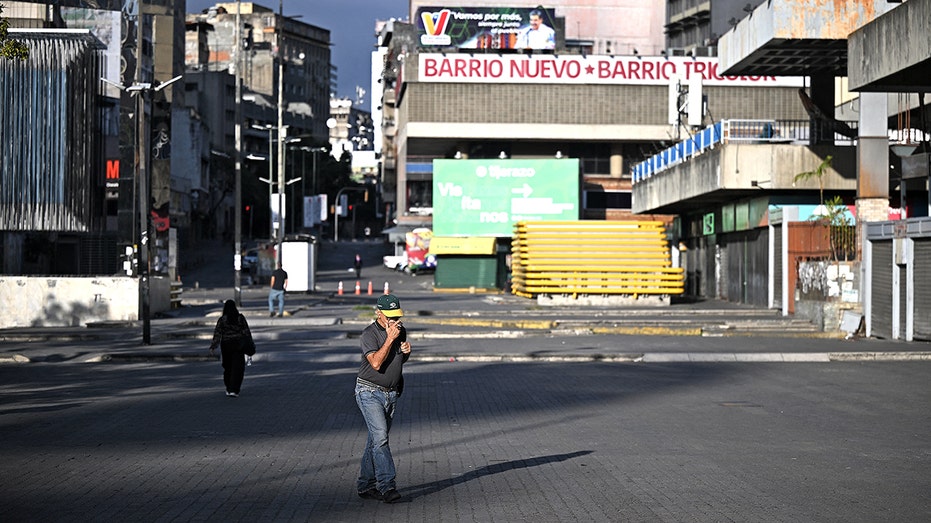
Following the ouster ofNicolás Maduro on Jan. 3 after he and his wife were whisked away to face justice in New York, ordinary citizens of Venezuela are responding with a mix of relief, shock and uncertainty after 30 years of a brutal socialist dictatorship that bankrupted their nation.
While what happens next remains largely uncertain and multiple possibilities continue to be studied by Washington, the celebratory tones seen across the country and throughout the almost 9 million citizens in the diaspora on Saturday have largely subsided into muted and cautious joy only expressed in private circles among those who longed for an end to years of economic hardship and political repression.
Vera, a professor at one of the better-known universities, told Fox News Digital, "The world cannot fathom the joy we feel. Maduro is in a federal prison in the U.S. with living conditions and rights that our political prisoners never had. For me, it is comforting to know he’ll spend the rest of his life behind bars eating rice and sausage and taking showers only three times a week, paying for damaging the lives of millions of Venezuelans."
PRESIDENT TRUMP SAYS THERE WON'T BE A 'SECOND WAVE OF ATTACKS' AGAINST VENEZUELA DUE TO THEIR 'COOPERATION'
Yet fear remains. The government has decreed any celebration of current events — and even expressions of approval of the U.S. operation in written text messages — to be a crime equivalent to national treason. Worse yet: it has empowered any law officer to check citizens and their telephones at random at hundreds of checkpoints established throughout Caracas and other regions of the country.
Anyone found in violation of the decree can be immediately arrested without a trial, turning the promise of change into an anxiety-tempered state about what comes next and raising questions about sovereignty, daily survival and how to overcome yet another crisis.
For Jesús, a 23-year-old university student from a middle-class family in Caracas who also works for a local business, a single word defines this past week: stress. For safety reasons, he and other Venezuelans interviewed for this story requested either partial or complete anonymity due to the security situation.
"We cannot afford the luxury of staying home and waiting to see how things will unfold. I have my own private vehicle and drive extensively throughout Caracas to go and come back from work, school, and run errands," he said.
AFTER MADURO, VENEZUELA POWER VACUUM EXPOSES BRUTAL INSIDERS AND ENFORCERS
"There are police cars and officers from the national, municipal and local authorities stationed in every corner. Hundreds of checkpoints have sprung up across Caracas since the decree forbidding any celebratory expression at the U.S. operation that captured Maduro. At the first few days, there were also pro-government publicly armed colectivos (state-sanctioned citizen collectivities) doing the rounds to capture and violently repress anyone so much as expressing relief that Maduro was gone. It’s been extremely difficult having to remain vigilant at all times. From prior experiences, I learned to avoid most checkpoints through alternate ways and avoiding main roads. People have been sending texts saying where the checkpoints are and telling us to delete anything that shows our support for U.S. actions from our phones."
He continued, "For me, personally, it’s a time of mixed feelings. I am relieved to see Maduro gone and finally see a promise or discourse by either local or foreign governments to come to pass in Venezuela. While I obviously understand this only happened because of foreign interference, I much prefer a U.S. action that ends this dictatorship than preserving Venezuela’s sovereignty at the cost of our country. On the other hand, I am also frightened, because once you start dismantling the established structures, you end up having chaos, and in such a case, the population suffers the most."
Jesús adds that he transits through three main large groups of people — his student friends, his family and older relatives and his job. He adds that among his friends the mood is largely of hope that the U.S. might reshape the Venezuelan market and develop it into what he calls a "developed" system, where people can actually lead a better life. "We’ll finally stop being a Cuban colony and either be truly independent or a U.S.-.led country like the Dominican Republic. Nothing wrong with that. We’ll still be better off and more stable," he added.
TRUMP BACKS MADURO LOYALIST OVER VENEZUELA OPPOSITION LEADER IN POST-CAPTURE TRANSITION
Among his relatives, the overarching tone is fear. So far, many of Maduro’s cronies remain in power, and they don’t know how they might suddenly react under paranoia, people with private property, and especially a potential mandatory military draft.
"Finally, at work, there is apathy. I work in a rich neighborhood where lots of government officers and military people frequent. Obviously, police officers and other government officials who benefited from the corruption and criminality are against what happened, but most military personnel say they won’t die for something they didn’t sign up for because of a dictatorship. At my work, we’ve seen so many broken promises, that we are only bracing to stay afloat," he concluded.
For Hannah, a recent graduate, there’s relief that Maduro is gone. "Obviously, things shouldn’t be like this, and Venezuelans should be the ones deciding the future of their own country, but Maduro had to leave one way or another, and now he is gone," she adds.
A business entrepreneur who asked to speak anonymously said there was very little inclination for Venezuelans in his position to speak to the press due to smear campaigns by the government and possible reprisals.
Based in Caracas, he said that stocks have been experiencing record highs in both trade and value since Saturday, with some of them reaching close to a 20% uptick since then.
"In the more pragmatic business elite in Venezuela, there is a lot of hope that a more normal business environment will be created now that Maduro is gone and if the U.S. plays the regime-change and economy-development cards right, even if it is to favor themselves foremost. But even then, this would be a better environment for private businesses and an enormous market ripe for renovated activity. In that sense, most people are hopeful that Maduro is finally gone, but obviously it’s hard to see your own country being attacked by a foreign power," he says.
Vera, the professor, says she has been out and about in Caracas since Jan. 4, and has not encountered any of the colectivos. She describes an overall sensation of relief a joy at seeing Maduro gone despite the many uncertainties.
"There is generalized uncertainty, but the collective sensation is relief. For the first time in 26 years of oppression, there is political change. I do have my personal reservations regarding Trump and the U.S., as there is evidently an economic interest on their part. We have one of the largest extra-heavy oil reserves in the world, on top of our reserves of gas, gold and coltan."
She continued, "The U.S. actions are not free, and we still need to see what the actual costs — which could be very high — will be. I am very sorry that this happened in my country and would be lying if I said I agreed with foreign incursions, but I am also of the opinion that our own Armed Forces should have listened to the majority of the citizens in the 2024 elections [when Maduro retained power despite losing the vote], but they chose to continue oppressing their own people. This is, therefore, part of the cost we should pay for their inoperancy," she said.
Vera cautions that reactivating Venezuela’s economic growth will be a medium- to-long-term task, but that when the feeling of political change is real, everything flows better, and the feeling of opportunity in the country is real right now.
